

A friend took a full-length photo of me at a wedding last year. I was wearing an outfit I loved. In person, I felt like the best version of myself. In the photo, I felt like someone’s aunt.
That photo made me realize something: I knew how to dress for the mirror. I did not know how to dress for the photo. They are not the same skill.
After eighteen months of small experiments, here is the single trick that changed my photos — and, weirdly, changed how I feel in mirrors too.
The trick: define one vertical line
Outfits that look great in person and terrible in photos usually share one problem: they’re drawing the eye horizontally. A belt at the natural waist. A contrast at the hip. A different-colored bottom. These all work in real life because the eye and the body are moving.
But the camera is static. A static eye looking at a horizontal break reads it as “this is where the body breaks.”
The fix is to give the eye a vertical line to follow instead. Three options:
Option A: A long pendant on a long chain
Not a choker. Not a princess length. A long pendant, two to three inches below the sternum. The eye follows the chain down to the pendant, reads the pendant as “this is the focal point,” and the silhouette stops breaking at the waist.
This works for me on days when I’m wearing a solid-color tee and jeans. The eye no longer sits on the natural waist.
Option B: An open jacket, lapels vertical
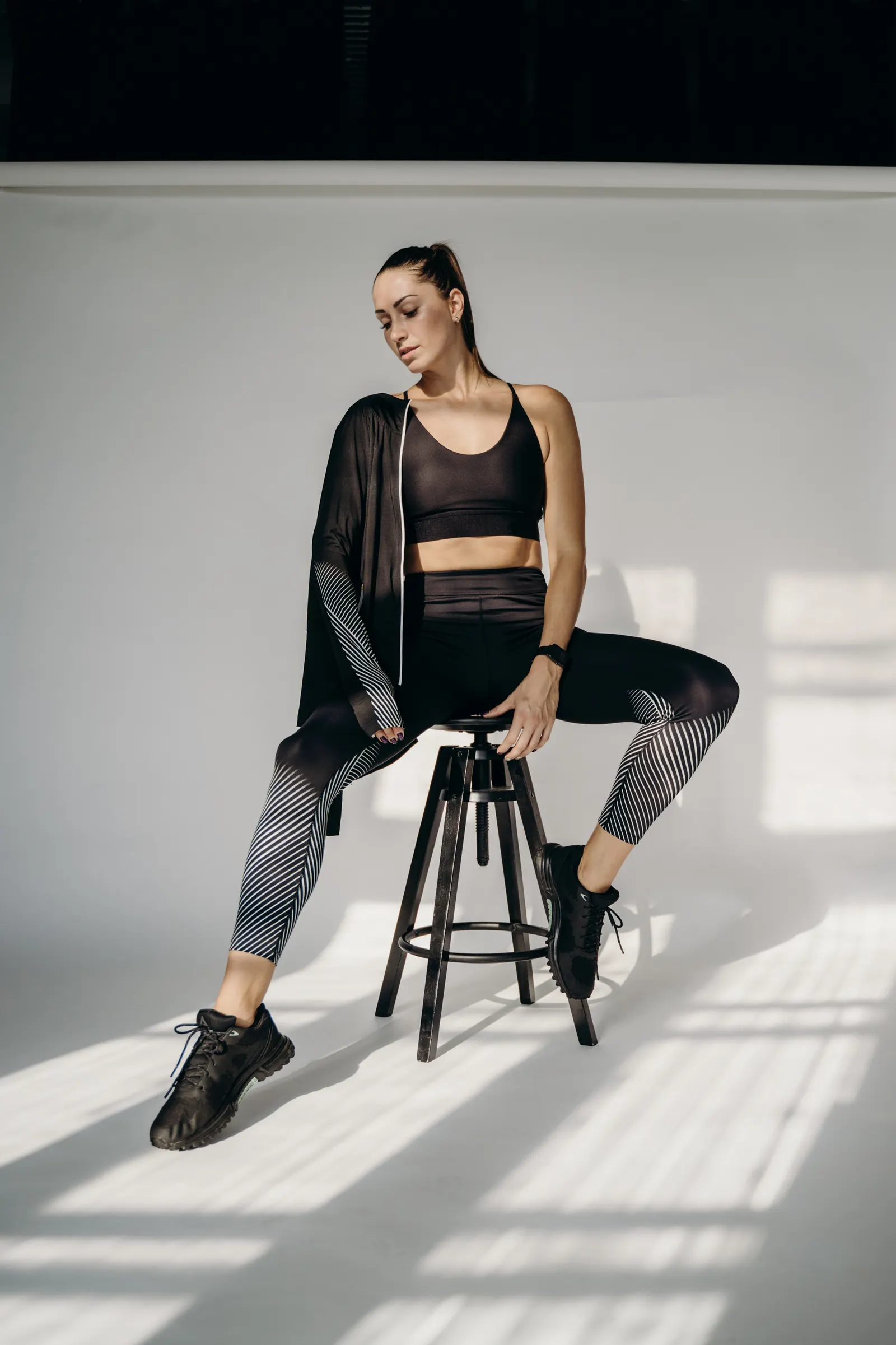
A blazer or jacket with structured lapels, left open, draws the eye up and down the front of the body. The lapels themselves become the vertical line.
This is why a blazer over a t-shirt looks “considered” in photos even when the body underneath is in a casual fit. The vertical is doing the work.
Option C: A scarf, draped long
A scarf is the most underrated vertical-line tool. A scarf hung from the shoulders down to the hip, never wrapped tight, just draped, draws the eye the same way a pendant does but with more presence.
This is the trick when I’m wearing a sweater with no other structure. The scarf adds the line.
Why this works (the actual reason)
Camera angles flatten proportions. The eye looking at a 2D image of a 3D body loses the depth cues that give real life its forgiving quality. The body in a photo is presented on a flat plane. Any horizontal break on a flat plane reads loud.
A vertical line, on the other hand, gives the eye length. Length reads as intentionality. Intentionality reads as confidence.
It’s also the trick that 1940s fashion photographers, 1980s fashion editors, and modern minimalists all use. The vertical line is a fashion photography trick that’s been hiding in plain sight.
When to skip it
There are days when I want to look soft. Look playful. Look approachable in a different way. On those days, I skip the vertical trick and lean into horizontal — a chunky belt, color breaks, cropped trousers.
The vertical is the photos move. It’s not the only move. It’s the one I keep going back to.
The book that taught me this
If you want the full version of this idea, read The Curated Closet by Anuschka Rees. It’s not a plus-size book. It’s a book about how to decide what to wear. The vertical-line idea is from there, applied to photographs specifically.
But the original insight — define one focal line for the eye — is a styling principle that predates the book. Most classic stylists know it. Most plus-size women don’t, because the styling world rarely shows us how the principles work on our bodies. They do.
What’s a styling trick that works for you? I’m collecting them for a future post. Send it to me.



Comments
Comments are coming soon — powered by Giscus (GitHub Discussions). To enable, fill in the
[params.giscus]block inhugo.toml. See privacy.